Abstract
This article examines the divergent pathways through which confidence develops among boys in African versus African American contexts. Drawing from personal reflection and scholarly discourse, it situates African boys’ confidence as culturally transmitted inheritance, while characterizing African American boys’ confidence as emergent armor—a response shaped by systemic oppression, historical trauma, and environmental adversity. The analysis engages theories of oppositional identity, racial socialization, and trauma-informed practice, culminating in recommendations for affirming and sustaining confidence in African American youth.
Introduction
Despite shared diasporic linkages, African boys and African American boys often experience markedly different socialization environments. This article analyzes how these differing contexts shape their formation of confidence, identity, and resilience, drawing upon cultural theory, education research, and trauma frameworks.
Confidence Through Cultural Inheritance
In many African societies, parents and community systems intentionally cultivate confidence as a developmental default. As one informant put it, they are raised “to be confident, to think a lot of themselves.” This intentional affirmation suggests that pride and self-possession are normalized rather than earned.
Psychological models of racial-ethnic socialization support this interpretation: children internalize group norms, values, and identities through guided familial and communal processes (Hughes et al., 2006). In African communities, such processes likely reinforce confidence as identity.
African American Boys: Confidence as Adaptive Resistance
By contrast, African American boys often forge confidence defensively—an adaptive response to pervasive dehumanization and systemic constraints. The historic and ongoing trauma associated with racialized dehumanization infiltrates domains such as education, criminal justice, and daily social interaction. Stevenson (2016) advocates a trauma-informed approach to affirm Black boys’ humanity and support healthy transitions to manhood.
This framework reveals how confidence is often armor rather than inheritance—needed to survive and resist systems designed to diminish them.
Theoretical Framework: Oppositional Identity & “Acting White”
Fordham and Ogbu’s (1986) notion of oppositional identity explores how African American youth may frame academic ambition as betrayal of collective identity, coining the concept of “acting white.” They argue that involuntary minority status fosters skepticism toward mainstream success, constraining identity through resistance (Fordham & Ogbu, 1986).
Subsequent research has nuanced this view, suggesting that while oppositional identity exists, it’s not the sole or dominant influence on academic outcomes. Still, the theory underscores the tension in cultivating confidence amid perceptions of cultural disloyalty.
Double Bind of Upward Mobility
African American boys raised in upwardly mobile homes may face a unique identity burden. They confront contradictory expectations: conforming to dominant norms may prompt accusations of “not being real,” while resisting them labels them underperformers. This dynamic echoes Ogbu’s framing of collective identity as protective yet restrictive.
Toward Strength-Based, Trauma-Informed Interventions
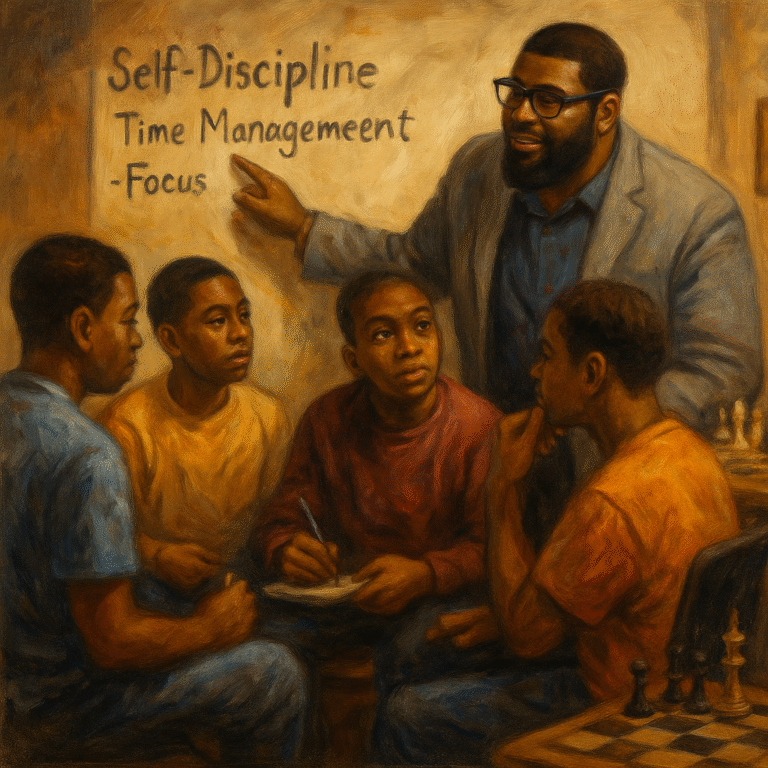
To shift confidence from armor to inheritance for African American boys, scholarship points to mentorship, racial socialization, and community anchoring.
Mentorship and group interventions bolster self-efficacy and internal support, enhancing confidence and resilience. Racial-ethnic socialization strategies—such as preparing youth for bias, affirming cultural heritage, and modeling resilience—serve as protective mechanisms. Trauma-informed frameworks urge educators and leaders to re-humanize Black boys through narratives of belonging and self-worth.
Conclusion
Confidence, in African contexts, often emerges as an inherited identity; but for African American boys, it frequently becomes a shield—resilience born of pain and resistance. Recognizing these different trajectories invites us to create conditions where confidence can be nurtured, affirmed, and inherited—not merely fought for. Through mentorship, culturally responsive education, and trauma-informed practices, we can move toward a future where African American boys inherit confidence as a right, not forge it as armor.
References
Fordham, S., & Ogbu, J. U. (1986). Black Students’ School Success: Coping with the “Burden of ‘Acting White’.” The Urban Review Ogbu, J. U. (1981). Cultural-ecological model of minorities and schooling. In [Details as available] Hughes, D., Rodriguez, J. P., Smith, E. P., Johnson, D. J., & Stevenson, H. C. (2006). Parents’ ethnic-racial socialization practices: A review of research and directions for future study. Developmental Psychology Stevenson, H. C. (2016). A trauma-informed approach to affirming the humanity of African American boys and supporting healthy transitions to manhood. In Boys and Men in African American Families (pp. 85–92). [Study on small-group interventions enhancing African American boys’ self-concept and academic engagement.] [Research on contemporary perspectives refinements of oppositional identity theory.]